Showing posts with label Gum Disease. Show all posts

Tuesday, December 8, 2009

Say NO to Gum Disease (Periodontal Disease) @Tooth Decay


To prevent the Periodontal (Gum) Disease @ Tooth decay, the most important thing is we have to brush our teeth for twice daily. Besides that, the correct way of brushing our teeth is the most important step when we are brushing our teeth.

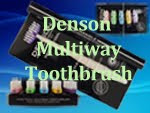
Normally, most people will brush their teeth using incorrect way naturally just like brush the teeth in the way from left to right or from right to left . Actually, the correct way of brushing our teeth is from up to down or from down to up. Hence, when you are using T-shaped toothbrush (Multiway Denson Toothbrush), you can smoothly brush your teeth in the correct method (in up and down method) and can completely clean your teeth whether it is in the inner part or outer part. Without of expectation, this two situations may enhance your interest in brushing your teeth especially your child who is still learning to brush their teeth and you will easily teach your child the correct method of brushing the teeth when using T-shaped toothbrush. T-shaped toothbrush meets the recommendation and increases the effectiveness when cleaning the teeth. For an example, T-shaped razor , it is easy to use and it does provides more cleaning action.


Futhermore, if we use ordinary toothbrush, you cant effectively brush the inner part of your teeth. Normally, the bacteria along with mucus and other particles, constantly and easily form a sticky and colorless "plaque" on your inner part of your teeth. When you are using this Multiway T-shaped toothbrush, you can be easily brushed the teeth in the inner part and effectively remove the coffee stains, tobacco stains and the plague that are on your teeth.

Multiway T-shaped toothbrush use high quality bristles (Dupont Nylon 612) and has been approved by the FDA of United States. Hence, when you are brushing your teeth, you will not easily get hurt the gum which would result in bleeding because you are using a high quality bristles.
In addition, when using Multiway T-shaped toothbrush, the user can easily control the speed, movement and direction of teeth brushing. 

Tooth Decay

Tooth decay is destruction or rotting of the tooth structure. Decay in the front teeth may adversely affect your appearance and self-esteem. Tooth decay is the most common cause of tooth loss in adolescents.
Tooth decay is caused by dental plaque. Bacteria in the plaque interact with food left-over in the mouth to produce acids, which attacks the tooth surfaces and causes decay.

Who are at risk?
Those with :
• frequent snacking on sugary foods.
• poor oral hygiene.
• reduced salivary flow.

How may you know that you have tooth decay?
You may experience :
• a hole in the tooth.
• pain.
• discomfort on brushing and chewing.
• food gets stuck in or between the teeth.
• unpleasant taste or smell in the mouth.


Are there further complications?
Yes, decay may lead to :
• swelling of the gums.
• dead (non vital) tooth.
• tooth loss.
• absence from work or school.
• unattractive appearance.

Sources are taken from :
http://www.myhealth.gov.my

Gum Disease (Periodontal Disease)


If you have been told you have periodontal (gum) disease, you're not alone. An estimated 80 percent of American adults currently have some form of the disease.

Periodontal diseases range from simple gum inflammation to serious disease that results in major damage to the soft tissue and bone that support the teeth. In the worst cases, teeth are lost.

Gum disease is a threat to your oral health.  Research is also pointing to possible health effects of periodontal diseases that go well beyond your mouth (more about this later). Whether it is stopped, slowed, or gets worse depends a great deal on how well you care for your teeth and gums every day, from this point forward. 

Periodontal diseases will happen because of our mouths are full of bacteria. These bacteria, along with mucus and other particles, constantly form a sticky, colorless "plaque" on teeth. Brushing and flossing help get rid of plaque.  Plaque that is not removed can harden and form bacteria-harboring "tartar" that brushing doesn't clean.  


The longer plaque and tartar are on teeth, the more harmful they become. The bacteria cause inflammation of the gums that is called "gingivitis."  In gingivitis, the gums become red, swollen and can bleed easily.  Gingivitis is a mild form of gum disease that can usually be reversed with daily brushing and flossing, and regular cleaning by a dentist or dental hygienist. This form of gum disease does not include any loss of bone and tissue that hold teeth in place. 

When gingivitis is not treated, it can advance to "periodontitis" (which means "inflammation around the tooth.")  In periodontitis, gums pull away from the teeth and form "pockets" that are infected. The body's immune system fights the bacteria as the plaque spreads and grows below the gum line. Bacterial toxins and the body's enzymes fighting the infection actually start to break down the bone and connective tissue that hold teeth in place. If not treated, the bones, gums, and connective tissue that support the teeth are destroyed.  The teeth may eventually become loose and have to be removed. 

People usually don't show signs of gum disease until they are in their 30s or 40s.  Men are more likely to have periodontal disease than women.  Although teenagers rarely develop periodontitis, they can develop gingivitis, the milder form of gum disease.  Most commonly, gum disease develops when plaque is allowed to build up along and under the gum line. 

Symptoms are often not noticeable until the disease is advanced. They include:
-          Bad breath that won't go away
-          Red or swollen gums
-          Tender or bleeding gums
-          Painful chewing
-          Loose teeth
-          Sensitive teeth

Sources are taken from:
National Institute Of Dental and Craniofacial Research